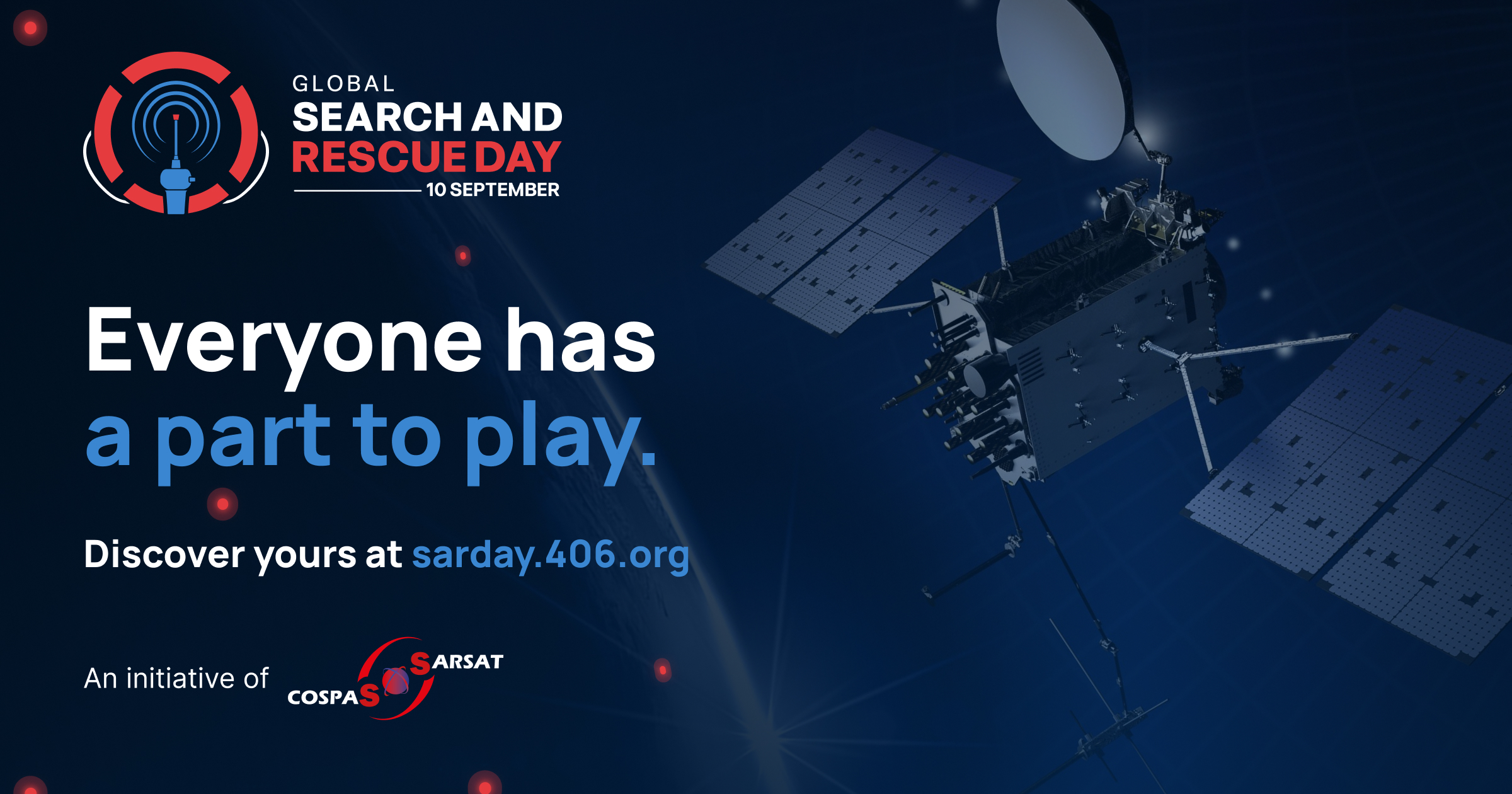
GLOBAL SEARCH AND RESCUE DAY — SEPTEMBER 10, 2026
Satellite-assisted rescue: Three major advances for the
International Cospas-Sarsat Programme
Through an array of new services, persons in distress receive confirmation of their signal for help, aircraft experiencing abnormal flight conditions automatically send distress notifications, and an increased number of orbiting satellite payloads enable faster detection and location of distress beacon transmissions.
On the occasion of the second Global Search and Rescue Day (Global SAR Day), the International Cospas-Sarsat Programme reaffirms its readiness to serve humanity with new capabilities transforming the speed and reach of emergency response communication. RLS-capable distress beacons can now confirm to persons in distress that their alert has been received and located by the Cospas-Sarsat system, and equipped aircraft can automatically transmit alert information when abnormal flight conditions are detected. The MEOSAR system uses multiple satellites simultaneously to determine a beacon’s location much more rapidly, allowing detection of a distress signal within minutes.
These advances build on an existing network that has helped save over 70,000 lives since 1982 — an average of four people saved per day since the programme began, rising to ten people per day in recent years thanks to technological innovations and operational improvements. Cospas-Sarsat relies on more than 70+ satellite payloads and 32 international mission control centres, monitoring activations of approximately three million registered beacons worldwide, at no cost to persons in distress.
“For decades, the Cospas-Sarsat satellite system has listened for distress signals around the world and alerted search and rescue authorities. With the Return Link Service, we can now close the loop, enabling confirmation between people in distress and the search and rescue groups responding to them,” stated Cheryl Bertoia, Principal Operations Officer at the International Cospas-Sarsat Programme. “For someone in distress at sea, in the mountains, or anywhere else on Earth, knowing that their alert signal has been received, and that help is on the way, can make all the difference. At that critical moment, a simple message of reassurance can turn uncertainly into hope.”
Three technological advances, a single mission
The beacon responds and confirms. Through the Return Link Service (RLS), maritime emergency positionindicating radio beacons (EPIRBs) and personal locator beacons (PLBs) can do more than transmit a signal: they are now able to confirm to the person in distress that their alert has been received, thus providing reassurance that the distress alert has been successfully acquired and its position determined.
Aircraft autonomous distress tracking.
Emergency locator transmitters with distress tracking (ELT(DT)s) now enable an aircraft to automatically trigger an alert and transmit its position when abnormal flight
conditions occur — even before any potential impact with ground or sea. This capability, adopted in response to recommendations stemming from prior aviation incidents, meets International Civil Aviation Organization (ICAO) standards developed in response to lessons learned from major aviation incidents and is intended to significantly improve the ability to locate aircraft in distress while still in flight.
Significantly faster detection and industry-leading location performance. The MEOSAR (Medium-altitude Earth Orbit Search and Rescue) satellite system — whose search and rescue repeaters are carried aboard the satellites of the world’s navigation constellations — is nearing the final steps toward full operational capability. By simultaneously using several satellites to very quickly determine a beacon’s location, this gain in efficiency will make a major difference when time is a critical factor.
“Every technological advance strengthens the same basic, constant, essential link: the human chain of rescue,” emphasized Shefali Juneja, Head of the Secretariat at the International Cospas-Sarsat Programme. “A satellite can detect an emergency, but it is people who make decisions, coordinate efforts, and save lives. Global Search and Rescue Day is dedicated to them, in recognition of the high-stakes work they accomplish each time someone is in distress.”
Behind every alert, someone is listening
Providing 24-hour monitoring, operators at the International Cospas-Sarsat Programme’s 32 international Mission Control Centres receive alerts from beacons and forward them to search and rescue teams around the world. To honour these dedicated individuals, Global Search and Rescue Day was established on September 10 — the date of the first satellite-assisted rescue in history, which took place in Canada in 1982 when three survivors of a plane crash were located by the Cospas-1 satellite.
The Cospas-Sarsat satellite-aided search and rescue programme reminds beacon owners of the importance of registering their devices, a free process that helps speed up the identification of the person when an alert is received. Operations, images, and statistics are available on the sarday.406.org platform.
About Global Search and Rescue Day
Celebrated annually on September 10, Global Search and Rescue Day marks the anniversary of the first satellite-assisted rescue in history (Canada, 1982) and pays tribute to the dedicated individuals of the global search and rescue network. Established by the International Cospas-Sarsat Programme, Global SAR Day marks its second year in 2026. Observed around the world, it is recognized by the programme’s institutional partners, including the International Civil Aviation Organization (ICAO) and the International Maritime Organization (IMO). sarday.406.org #GlobalSARDay #GlobalSARDay